
The Secret History of Paris
Paris is so full of history, art, high fashion and intellectual life that it can feel overwhelming to try to get to know it. Most of the “secrets” in this blog post are actually quite well-known—but they’re things that many people feel they should know about but don’t know where to start. Dr. Orton explains that the secret to getting to know Paris is to take cue from its history…

Paris has always been a symbol of culture and sophistication, and many people feel that to be really educated, they should be familiar with it. There’s so much to see and learn, though, that it’s difficult to know how to get to know the city in a brief trip. In this brief overview of the city’s history, I’m going to suggest some of the best places to start.
A City Shaped by History
People have been living on the banks of the Seine in the Paris area for thousands of years and today, the Seine’s two islands—the Île de la Cité and the Île Saint-Louis—are home to two of Paris’ religious sites: Notre-Dame Cathedral and the Church of Saint-Louis en l’Île.
Paris began its Roman life as Lutetia, a provincial settlement on what is now the Île de la Cité and part of the Left Bank. It was a garrison town within greater Gaul, but was abandoned following attacks from Germanic tribes in the late fifth century AD. A lot of Paris’ Roman buildings were lost, although the Arènes de Lutèce amphitheatre and other buildings were rediscovered in the nineteenth century.
Paris remained a small city for many centuries, but became an intellectual hub following the establishment of the Sorbonne in the thirteenth century. The Sorbonne’s district on the Left Bank became known as the Latin Quarter and developed a reputation for illuminated manuscripts and (after the invention of the printing press) publishing.
For much of the medieval period, Paris flourished as a centre of trade, politics and religion, particularly with the building of Notre-Dame Cathedral in the twelfth century. I love Notre-Dame’s rose windows, ribbed vaults, flying buttresses and its (mostly nineteenth century) gargoyles.
In the fourteenth century, however, things became more difficult. The ruling Capetian dynasty, ran out of male heirs in 1328. This started a succession dispute and led to the Hundred Years’ War between the English and French. The English were victorious at the battle of Agincourt in 1415, leading to the crowning of Henry VI of England as King of France and an English occupation of Paris from 1420 to 1435. Paris also lost half its population during the Black Death of the 1340s.
Renaissance, Enlightenment and the Age of Revolution
During the Renaissance, Paris gained buildings like Hôtel de Ville (the City Hall), which was rebuilt in the same Renaissance style in the nineteenth century.
The Bourbon dynasty also left its mark on the city. The Sun King, Louis XIV, succeeded to the throne as a child in 1638. He commissioned Hôtel des Invalides to care for wounded soldiers and the Palace of Versailles, with its famous Hall of Mirrors, ten miles southwest of Paris. The Palace has many allusions to Apollo, the Greek sun god—laurel wreathes, lyres and tripods are all combined with royal portraits and emblems.
In seventeenth century Paris, the art world was consumed by the debate between the those who advocated for idealised, classical forms in painting (admirers of Nicolas Poussin) and those who thought that colour should be prioritised over line (admirers of Peter Paul Rubens). You can see examples of both of these styles at the Louvre—look out for Poussin’s Les Bergers d’Arcadie (The Arcadian Shepherds) and Rubens’ sequence of paintings on the life of Marie de’ Medici.
The Rubenists scored a partial victory in the eighteenth century, when Antoine Watteau was entered into the Académie Royale de Peinture et de Sculpture (Royal Academy of Painting and Sculpture) with his painting Pèlerinage à l’île de Cythère (Pilgrimage to Cythera; 1717), which you can also see at the Louvre. This created a new type of painting called the fête galante, which was focused on aristocratic entertainment.
The Champs-Elysées and the Place de la Concorde (Place Louis XV) were constructed in the eighteenth century under Louis XV. The Place de la Concorde saw the end of French royalty itself. On the 14th of July, 1789, revolutionaries stormed the Bastille, where political prisoners were held. In August, Louis XVI and his family were seized in the Tuileries Palace. Louis XVI and his wife Marie Antoinette were executed at Place de la Concorde in 1793.
This revolution was partially inspired by ideas that had been circulating throughout the eighteenth century. The Ancien Régime (“Old Order”) was challenged by the writers of the French Enlightenment—Voltaire, Jean Jacques Rousseau, Montesquieu and Denis Diderot, all of whom spent time in Paris.
Paris in the Nineteenth Century
After the revolution, France was governed by Napoleon Bonaparte. Napoleon was crowned Emperor of the French at Notre-Dame in 1804. Napoleon liked the neoclassical style and commissioned the Arc de Triomphe in 1806 to commemorate his victories in war. He was buried at Les des Invalides, originally a hospice for war veterans that Napoleon had expanded and renovated.
Following Napoleon’s defeat at Waterloo, his son, Napoleon II, was Emperor for twenty days in 1815. Then followed the Bourbon Restoration, with the rule of Louis XVIII and Charles X. Charles X was overthrown in the July Revolution (1830). Honoré de Balzac’s Le Père Goriot (“Old Goriot” or “Father Goriot”) is set in Paris in 1819, during the Bourbon Restoration, and explores Paris’ changing social structure during the time.
In the July Monarchy, (1830–1848), Louis-Philippe (“the Citizen King”) ruled in a constitutional monarchy (dominated by the wealthy bourgeoisie). Under his reign, the Luxor obelisk was erected in Place de la Concorde, having been gifted to France by the Egyptians 1829 in recognition of Jean-François Champolion’s work on deciphering of hieroglyphics.
This is one of my favourite periods in French intellectual history. The Journal des Debats newspaper was under the direction of Louis Francios Bertin, whose 1832 portrait by Ingres is one of my favourite paintings. You can see it at the Louvre.
It was also a great time for French literature. Victor Hugo’s Notre-Dame de Paris was published in the 1830s. Hugo’s gothic novel follows the hunchback Quasimodo and the Romani Esmeralda in Renaissance Paris.
Growing discontent with Louis-Philippe’s reign led to his overthrow in 1848. Napoleon I’s nephew Napoleon III was elected President of France, becoming Emperor of the French from 1852 until his deposition in 1870.

Napoleon III’s Prefect, Baron Georges-Eugène Haussmann, transformed Paris during the nineteenth century from a city of narrow, dark streets to one of wide boulevards, tree-lined streets, buildings with wrought iron balconies, tall windows, and ornate cornices. Boulevard Haussmann and Boulevard Saint-Germain are good examples of Haussmann’s Boulevard system. Visit the Eighth Arrondissement to get a feel for Haussmann’s wide, open spaces—and while you’re there, you could stop at Ladurée on the Champs-Élysées or Rue Royale for their famous macaroons.
Charles Baudelaire’s poetry often evokes Haussmann-era Paris in its transitions state. His Les Fleurs du Mal (“The Flowers of Evil”) collection of poetry is known for its dark, moody verses, like Le Vampire (“The Vampire”) and—one of my favourites—La Géante (“The Giantess”).
Baudelaire is depicted in Édouard Manet’s impressionist Music in the Tuileries Gardens (1862). This is held by the National Gallery in London now, but it’s worth visiting the Tuileries to imagine what the gardens were like at the time. You can also see more paintings by Manet and other impressionists at the Musée d’Orsay.
Napoleon III also introduced a water system, sewer network gas lighting, and public parks, hoping to improve the living conditions of the working class and reduce social unrest. Having said that, Haussmann’s projects also dislocated many poorer people from the city. It was in this era that the Place de l’Opéra and Opéra Garnier were designed and built between 1861 and 1875. The Opéra Garnier is the setting for Gaston Leroux’s novel, The Phantom of the Opera (1909).
La Belle Époque and the World Wars
After the Franco-Prussian War (1870-1871) followed La Belle Époque, a period which lasted until World War I. This period saw the rise of Art Nouveau—a style that uses organic, sinuous forms inspired by nature, soft pastel tones and mixtures of materials such as iron, ceramics, stone and stained glass.
Many of Paris’ Métro entrances were designed by Hector Guimard between 1900 and 1913 in the Art Nouveau style and the glass dome at Galeries Lafayette is typical of the style. You can also take in the Art Nouveau and Art Deco details at Maison Angelina while you try their legendary hot chocolate.
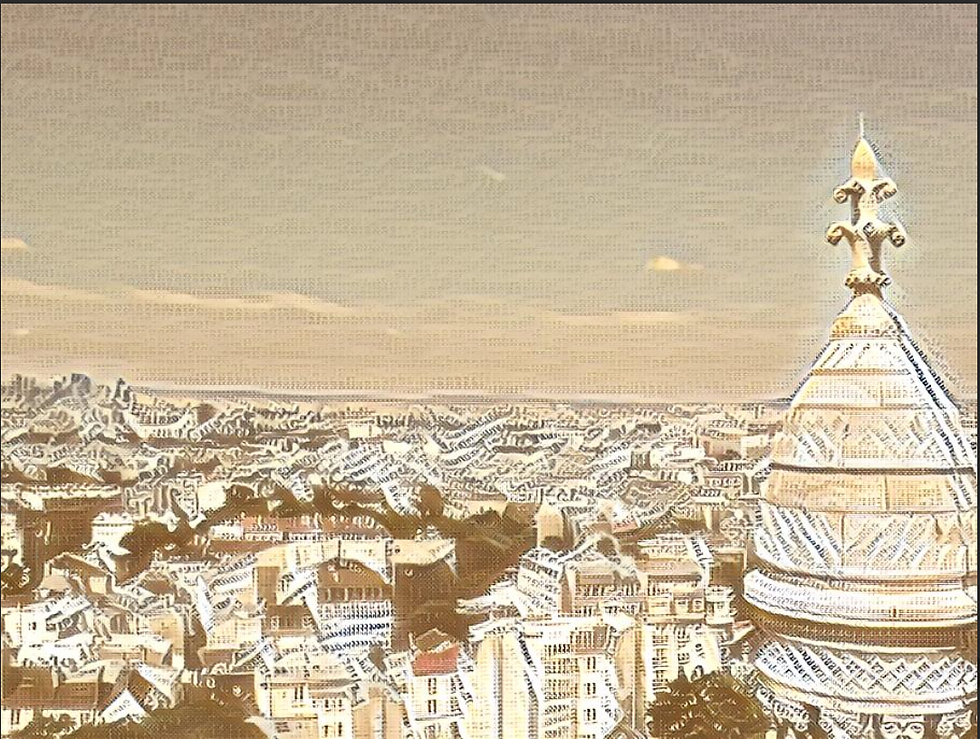
The Sacré-Cœur was constructed on Montmartre in the Eighteenth Arrondissement between 1875-1914 and the Moulin Rouge opened in the Pigalle red-light district at the foot of Montmartre in 1889. Also in Montmartre at the time, Edgar Degas was painting his famous ballet dancers and Vincent Van Gogh spent a couple of years here with his brother.
If you visit the Musée d’Orsay in the Seventh Arrondissement, look out for Pierre-Auguste Renoir’s Moulin de la Galette (1876) to see an impressionist take on a working-class gathering at Montmartre. Don’t forget the post-impressionists—Musée d’Orsay also has a big collection of these—look out for works by Van Gogh, Gauguin and Cézanne.

Paris’ fortunes fell after the two World Wars of the twentieth century, but it retained its reputation as an intellectual hotbed. Existentialist philosophers like Jean-Paul Sartre and Simone de Beauvoir were known for their contribution to the intellectual life of the Left Bank in the late 1940s. Satre and de Beauvoir were regular patrons of the famous literary café Les Deux Magots, opposite the city’s oldest church, Église St-Germain des Prés. The café was also a favourite hangout of writer Guillaume Apollinaire, surrealist poet Louis Aragon, writer André Gide—one of my favourites—novelist and essayist Jean Giraudoux, painter, sculptor and filmmaker Fernand Léger, poet Jacques Prévert, American writer Ernest Hemingway and surrealist writer André Breton.
My Favourite Arrondissements
Paris divided into twenty arrondissements (districts), which spiral in a clockwise arrangement from the Rive Gauche (“Left Bank”; the south) of the of the River Seine, encompassed by the périphérique (ring road) surrounding the city.
The First Arrondissement is a must-see for everyone, home to Musée du Louvre, the elegant Jardin des Tuileries and the quieter Jardin du Palais Royal. It’s a byword for luxury, home to the Place Vendôme with its famous jewellery brands and the boutiques of Faubourg Saint-Honoré. You’ll find it on the Rive Droite (“Right Bank”) and it includes the western section of the Île de la Cité, including the medieval, gothic-style Sainte-Chapelle with its 1,113 stained glass panels.
The Fourth Arrondissement contains the Marais district and is home to historic Mariage Frères Tea House. It’s one of my favourite districts to walk around, especially during quiet times, or at night when it is lit up with the warm glow of cafes and restaurants.

The Fifth Arrondissement—also known as the Latin Quarter—fans out around La Sorbonne’s university campus on the Left Bank. One of my favourite places to visit is the sixteenth-century Church of Saint-Étienne-du-Mont in the fifth arrondissement. It has a shrine to St. Geneviève, the patron saint of Paris and is near the Panthéon (the impressive neoclassical monument that was originally supposed to be a Church dedicated to St. Geneviève). I love its mix of Gothic architecture and Renaissance style and especially its intricate spiral staircase.
The Fourteenth Arrondissement is mostly a residential district; it’s where I’ve stayed on the few occasions I’ve stayed with a French family while doing language courses in the city. It has the entry point for Les Catacombes, subterranean tunnels that hold the bones of over six million people. The tunnels were created as part of the stone quarries—the limestone from which was used to build Notre-Dame—and they were turned into an ossuary in the late eighteenth century to solve the problem of Paris’ overflowing cemeteries.
Of course, these are just some of my favourite spots in the city—but hopefully this will give you a good idea of where to start!
Find Out More
Dr. Orton also explores the secrets of other European cities in her blog posts about Durham, Oxford, Siena, Bologna, Berlin, Athens and Leicester.
You might be interested in our Intellectual, Cultural and Art History course, Nineteenth Century French Art and Thought. If you’d like to learn more about Historical Mysteries, we have suggestions for a customisable course on this on our History page. Alternatively, if you’re interested in the rare, the niche and the esoteric aspects of the world’s most fascinating cities, take a look at our Interdisciplinary course, The Secret History of Cities.
These courses are templates of possible routes of study and can be combined, adapted, or designed from scratch to suit your interests and goals. Dr. Orton will work with you to design a course of private tutorials tailored to your needs, ability and schedule—whether you are undertaking your own research for an independent project, writing a book or simply have a personal interest. Click the link to find out what it’s like to work with her.
Contact us to find out more!
Undertake Your Own Research Project
Working on your own independent research project needn’t be a lonely task: Dr. Orton works with other independent scholars on projects in conservation and the humanities. Contact us for a chat with her.
If you’re not ready to reach out yet, follow our research methods series on this blog for more ideas! Dr. Orton has written posts on the importance of independent research and how to get started with building your own approach to ethical, people-centred fieldwork.
Reach Out
Follow our Orton Academy Instagram—we would love to connect with you!

