
The Hidden Himalayas: More Stories from Spiti
Following the broadcast of Mountain Spirits of Spiti on the BBC World Service, Dr. Orton hears more from residents about the narratives that informed the documentary.

I’ve been travelling to Spiti Valley, in India’s high-altitude Himalayas, for over a decade, researching local folklore and wildlife narratives. My recent documentary for BBC World Service, Mountain Spirits of Spiti, is about the invisible folklore of Spiti, and it couldn’t have been made without the collaboration of local people. We weren’t able to include everything in a documentary of this length, so here are some more narratives from locals about the hidden Himalayas.
Biyul (Hidden Lands)
Biyul are hidden lands that coexist with the mundane world; some villagers have seen and entered them:
“Khar village is said by the ancestors to be a biyul. Someone with sheep and goats travelled high into the mountains. He saw a whole village. He went there and was fed by the people. They said they had no needs except salt. He went back with salt and saw that only the things that he had touched in the biyul remained: the stones that he had sat on and the plate from which he had eaten” (Gormet Kalzang, Sagnam village 2016).
“There is a biyul in Lungdak…Our Rinpoche, Lochen Tulku…Not this one—his previous incarnation—said that there were two houses: one rich and one poor. When he was passing through that place, they served him tea and food. After that, he asked the people, “Should I bring them out?” But then there would be a problem with water in that place, so he didn’t do it” (Chetup Dorje, Rangrik village, 2025).

“In ancient times, Chicham was also considered a biyul. And now there is one biyul at Rangrik Lungda. At that place, there were two houses: one belonged to a rich person and the other to a poor person. In ancient times, the previous incarnation of Lochen Tulku Rinpoche passed by that area. He was offered tea and snacks there, and from that place he brought a hot teapot. That is what people used to say” (Lobzang Chopel, Chicham village, 2025).
“In Kiato, in the evening time, we can see something a little similar to animals moving around the houses. There was a tree on the opposite side of Kiato. It looked like animals or something like that…Chicham, Gyuyul (Demul), and even the Mane villages were once biyul” (Chopel Tandup, Chicham village, 2025).
Balu Thukangbu
Balu Thukangbu is a wish-granting being who is one foot tall, wears a one-foot-tall hat and carries a one-foot-tall stick:
“Someone in Demul managed to get hold of him and kept the stick in a place too high for him. The person kept him as a servant for many years. One day, everyone was in the fields, ploughing. Only an old woman was home. Balu was sent to get a stick from the village. The old woman gave him his own stick, so he got his own stick back and escaped. Balu cursed the village” (Dichen Zangmo, Sagnam village 2016).
“Balu Thukangbu…has some extra flesh on his legs. And if we press on that then he couldn’t go anywhere and sit there. And if we can’t press it then he will run away and hide himself. He has one small cap; if he wears that cap, then he hides himself and we can do nothing… if we capture him then he will ask what do you want, money or lifelong? If we say I want a lifelong, then he will grant it. And if we say I want money then he will give us money. And he also has a cap. If he wears that then he will hide himself even if he is nearby…His cap is known as Divi-shichung” (Gathuk, Kee Old People’s Home, 2025).
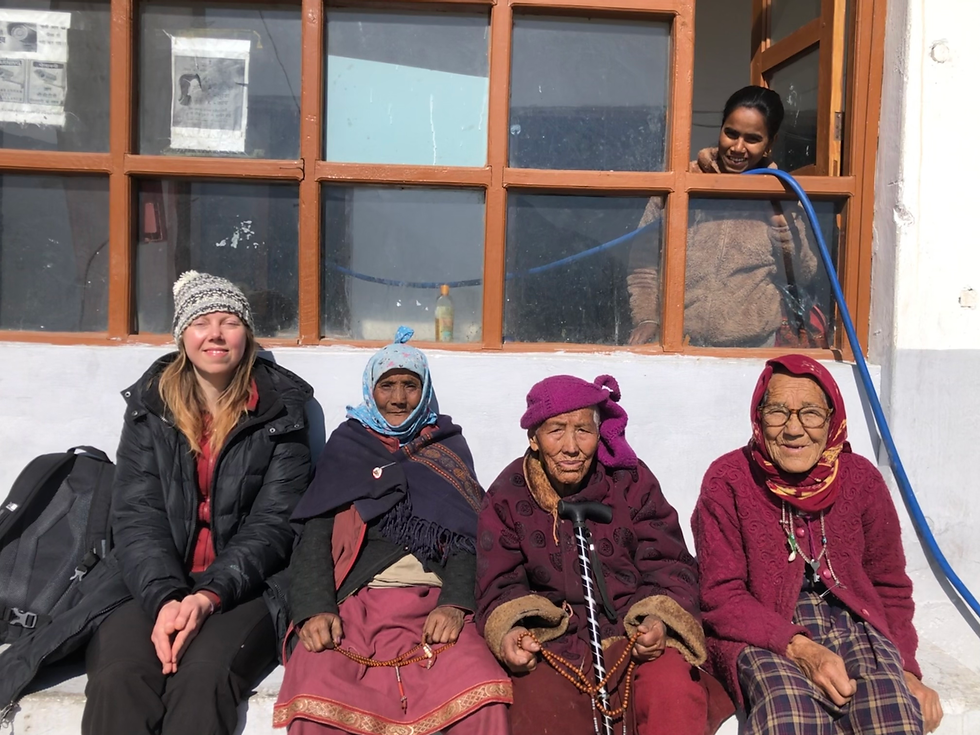
“In Norbu’s home, there was a man…There was a small cap and a wooden stick. If we hid that wooden stick and took it from him, then he could not go anywhere. He worked really well and also gave a lot of money. One day, when they went to plough the field, as they were ploughing, the plough handle connector broke…He said, “Go home and tell grandmother that the plough handle is broken, so give me another small piece of wood.” And Balu went home and told his grandmother, “Grandfather said to give the small cap and the thick wooden stick. Our plough handle is broken.” When he got his cap and stick, he just ran away with them” (Phunchok Namgyal, Kibber village, 2024).
“Once, a woman near Kibber was looking for cows—but found Balu. She asked for her cow (“shui”). “Shui” also means spots as in chicken pox. Balu gave her the pox instead. This was a misunderstanding: Balu was not being malicious…If you want to travel to another place (in our world), then you think of that place and you travel there. Balu will be lost in that case” (Tenzin Dakpe, Tashigang village, 2026).
Lhas
Lhas are local deities who can be called upon for help:
“We go to the lha when we become ill or something happens to our body: if we have some serious disease or are cursed. Then the lha tells us, to do kurim [cleansing ceremony/protective rituals]… We invite lamas and Chova [tantric] to perform rituals and prayers…we will invite lamas to perform kurim and do tana mana” (“Grandma”, Kee Old People’s Home, 2025).
“The lama said, ‘One member of your family, a girl, has gone to the watermill where grains are ground. If you meet her on your way, please do not frighten or startle her’…On the way home, the girl saw a sandstorm coming toward her. The lha could see the girl, but the girl could not see the lha—she only saw the sandstorm. The lha changed his direction toward Chicham Bridge, and the storm jumped from the cliff to the Kibber side. When the girl reached home, the lama asked her, ‘Did you meet someone or a man?’ She answered, ‘No, I didn’t, but I saw a sandstorm. First it was coming toward me, then it suddenly changed direction and jumped through the Chicham cliff to the Kibber side.’ That’s how the lama and lha used to talk to each other” (Phunchok Namgyal, Kibber village 2024).
“While I was doing some work, I saw man-like creature with a big red head [the colour red defends the lha]. Then I knew that he was a Kibber lha, and I was afraid that he wanted to curse me. When I was done with my work and returning home, there was a small bridge [under the Chicham bridge]…suddenly a mild sandstorm came from the top and it fell over me. But there were no stones, only sand…I had a bad feeling that he wanted to curse me. So when I reached home, I called upon the lha and told him about everything that happened to me. And the lha said, ‘I came to test you, to see what you would do’” (Phunchok Namgyal, Kibber village 2024).

“On the way home [from Tabo to Kibber; just passed Poh village], there was an uphill slope. While climbing that slope, I saw a man who was wearing a woollen lokpa robe. So I thought I would walk with that man. When I got tired and rested for a while, he also rested. When I started walking again, he also started walking. There was a small mountain stream, and I was about to reach near him. After crossing that, he suddenly vanished. There was a store where no one was there. I sat for a while and smoked. Then I went to search for him while calling out to him on the slope, but he wasn’t there. So I came back and met some Dhankar shepherds. I asked them, ‘Did you see a man coming here?’ They said, ‘No, we didn’t see any man. You are the only one who came through this way.”’ There was a small lake, and at that time there used to be heavy snowfall. Then I heard some noise. I looked around, but there was nothing. When I looked to the other side, there was a huge sandstorm coming towards me…I got the feeling that it was the Kibber lha. I said, ‘Don’t come with me. The villagers have already offered you goat and barley. I am the village head, but you are a powerful lha. Don’t come with me.’ And the sandstorm went away (Phunchok Namgyal, Kibber village 2024).
“Pangmo (between Kaza and Losar) used to be a village above the road, in which the villagers used enjoy parties. The lha came to them in the form of an old lady (note that elderly people sit above the young). This old lady looked horrible and unclean so the villagers did not treat her with respect. A young lady invited her in but the old lady sent her far away. She revealed herself as the lha and brought the glaciers down. The village was destroyed and everyone died except the young lady” (Dorje Namgyal, Chicham village 2015).
The Larpey
A larpe is like a lha, but one who kidnaps and hides people:
“It happened to Evi Chhering, Funchok Namgail’s mother, in earlier times…Once she hid herself, then the larpey hid her, and people couldn’t find her. She was offered sausage and a fire as well” (Dolma Butith, Kibber village 2025).
“And even if that person is sitting here, people who are searching for her cannot see her. Even if she is right here, they won’t see her. This happened to Tseshu …She said she was going to Changthang, but instead she hide…Then, on the other side in Bandey, she stayed there. For three to four days, she was missing, and people were searching for her but couldn’t find her. Later, she said that she was in Damzang—the place where people eventually found her. She had been sitting there while people were walking right in front of her. She could see them, but they couldn’t see her. That’s what she used to say” (Chetup Zangmo, Kibber village 2025).

The documentary was broadcast on the 25th September 2026. Click the link to listen to Mountain Spirits of Spiti!
Find Out More
To learn more about Dr. Orton’s research in the Himalayas, click the link to read her blog posts in our People and wildlife in South Asia series! Dr. Orton has posts on the snow leopards of Spiti, legends of Spiti’s hidden lands, and Spiti’s history in the Tibetan Empire.
You can also listen to Dr. Orton’s talk about the Hidden Himalayas at Oxford University!
Also, don’t visit Spiti before reading what locals want you to know about how to go beyond the bucket list and find the real Spiti!
There are also academic lectures on Dr. Orton’s fieldwork in the Himalayas on our Research Page.
If you’re interested in tutorials with Dr. Orton, she offers online, one-on-one tutorials that are based around your learning or research needs. This ranges from ad hoc tutorials to gain an understanding of the academic literature, research proposal feedback and development, or regular, ongoing support. To find out more about the anthropology and folklore of the Himalayas, take a look at our Anthropology courses on Tibetan and Himalayan Studies, Himalayan Folklore and Religion of the Himalayas. Our interdisciplinary course on Culture and Conservation will give you an insight into the link between wildlife and anthropology.
These courses are templates of possible routes of study and can be combined, adapted, or designed from scratch to suit your interests and goals. Dr. Orton will work with you to design a course of private tutorials tailored to your needs, ability and schedule – whether you are undertaking your own research for an independent project, writing a book or simply have a personal interest. Click the link to find out what it’s like to work with Dr. Orton.
Contact us to find out more!
Undertake Your Own Research Project
Working on your own independent research project needn’t be a lonely task: Dr. Orton works with other independent scholars on projects in conservation and the humanities. Contact us for a chat with her.
If you’re not ready to reach out yet, follow our research methods series on this blog for more ideas! Dr. Orton has written posts on the importance of independent research and how to get started with building your own approach to ethical, people-centred fieldwork.
Reach Out
Follow us on Orton Academy Instagram to see pictures from Dr. Orton’s fieldwork in the Himalayas and the Sundarbans – we would love to connect with you!


