
The Birch Tree: A Symbol of Femininity and Fertility
Updated: Mar 16
Many of our native trees have a special association with Anglo-Saxon paganism. In this week’s post, Dr. Orton investigates the birch tree. Part of our Trees and Anglo-Saxon Paganism series, in which we explore the links between our native British trees and Anglo-Saxon paganism!*
This series is more academically dense than some of our other posts. For a quicker, more accessible read, take a look at our posts about our baby tawny owls, polecats or animals that live in our woods at night!

England has two common native species of birch trees: silver birch (Betula pendula) and downy birch (Betula pubescens). Silver birch has silver-white bark and triangular-shaped leaves. It is monoecious (male and female flowers—catkins—are found on the same tree) and flowers from April to May. Male catkins hang like lambs' tails, whereas female catkins are smaller and perky. These are pollinated by wind, after which female catkins thicken and turn from green to crimson.
Silver birch can hybridise with downy birch, which is more upright than silver birch, with horizontal grooves in its bark and hairy twigs. Downy birch is also monoecious, flowering from April to May, lambs’-tail male catkins and shorter, perky female catkins.
Both species of birch are great for soil quality, as its roots spread widely to reach nutrients that would otherwise be inaccessible. When the leaves fall, these nutrients reach the soil surface. It’s also great for wildlife: as the Woodland Trust points out, birch wood canopies are light and open, so the ground beneath has grasses, mosses, wood anemones, bluebells, wood sorrel and violets.
Caterpillars of angle-shades, buff tip, pebble hook-tip, and Kentish glory moths love birch, as do many other species of insects. Woodpeckers and other hole-nesting birds live in birch trunks, and siskins, greenfinches and redpolls eat the seeds.
The Forest Commission recorded 103 species of fungi on birch trees. Silver birch often has fly agaric, woolly milk cap, birch milk cap, birch brittlegill, birch knight, chanterelle and the birch polypore fungi.
Humans also love birch trees. According to foraging organisation, Wild Foods UK, birch sap can be harvested in spring to make drinks. The betulin and betulinic acid in birch bark is used in cancer treatment. Birch twigs are also used as traditional thatching and weaving material.
The Birch on the Island of Freyr
Excavations in the choir of Frösö (“island of Freyr”) Church in Jämtland, Sweden revealed animal bones scattered around the remains of a birch tree, deposits that were dated to the late Viking Age (late tenth to early eleventh century). Ola Magnell and Elisabeth Iregren argue that this likely represents the remains of the blót (Old Norse sacrifice and feasting) and disablót (the blót held in honour of the female spirits or deities).

The bones of farm animals and wild game were found, but those of pigs and brown bears seem to have special importance. Pigs are associated with the god Freyr—click the link to read about Freyr and the sacred boar in the pagan festival of Yule!
Iregren suggests that the birch tree represents the world tree, Yggdrasil, which is usually thought to be an ash tree. This might be an association particular to this area, as Historian of religion Britt-Mari Näsström argues that the bones of wild game and bear together combined with the birch tree show the influence of Saami culture on the island.
Archaeologist Anders Andren argues that the is evidence that votive trees with cosmic associations existed in Viking age Scandinavia. Anders says that there is also a possible association with the mythical tree Lærad (sometimes, but not always, associated with Yggdrasil) that stood by Valhal (Odin’s residence and the realm of the dead for fallen warriors). This is because before the Church was built over the site, the tree was the focus for the surrounding barrow cemetery and single three-pointed stone setting.
Frig and Fertility
Birch trees are associated with femininity in some Northern European sources. Icelandic historian and poet Snorri Sturluson, in his Skáldskaparmál, a guide to Old Norse poetry, says that men and women are associated with different trees and that birch is aligned with women.
D.J. Conway links the Birch tree in the Elder Runic alphabet with the goddesses Frigg, Nerthus (Germanic earth goddess described by Tacitus) and Hel (goddess of the underworld), categorising its meaning as “Creativity, new beginnings, birth, marriage” and says that Birch was “the tree of conception and birth to the Norse.”
I couldn’t find primary source evidence to support this link, but it is popular to associate the birch rune with female goddesses, especially those with a connection to fertility. Edred Thorsson also links the birch rune to the earth goddess, saying:
“Berkano [the birch rune] rules over the four pivotal human “rites of passage,” which take place at the crucial times of birth, adolescence, marriage, and death. This birch goddess also displays the darker side of the ‘Terrible Mother,’ ruling over death. In Norse mythology she is represented by Hel…The B-rune is the container of all becoming/being. It is the unity of the birth-life-death-rebirth cycle through the ‘mystery of the moment.’ This is the ‘unit of evolution,’ that moment of ‘being’ (a single complete cycle of arising-being/becoming-passing-away to new arising) from which ‘becoming’ is built. The phenomenon of chance in nature is described by this rune, because each moment each of these units of existence has its own uniqueness, although they are all held together by a universal pattern.”
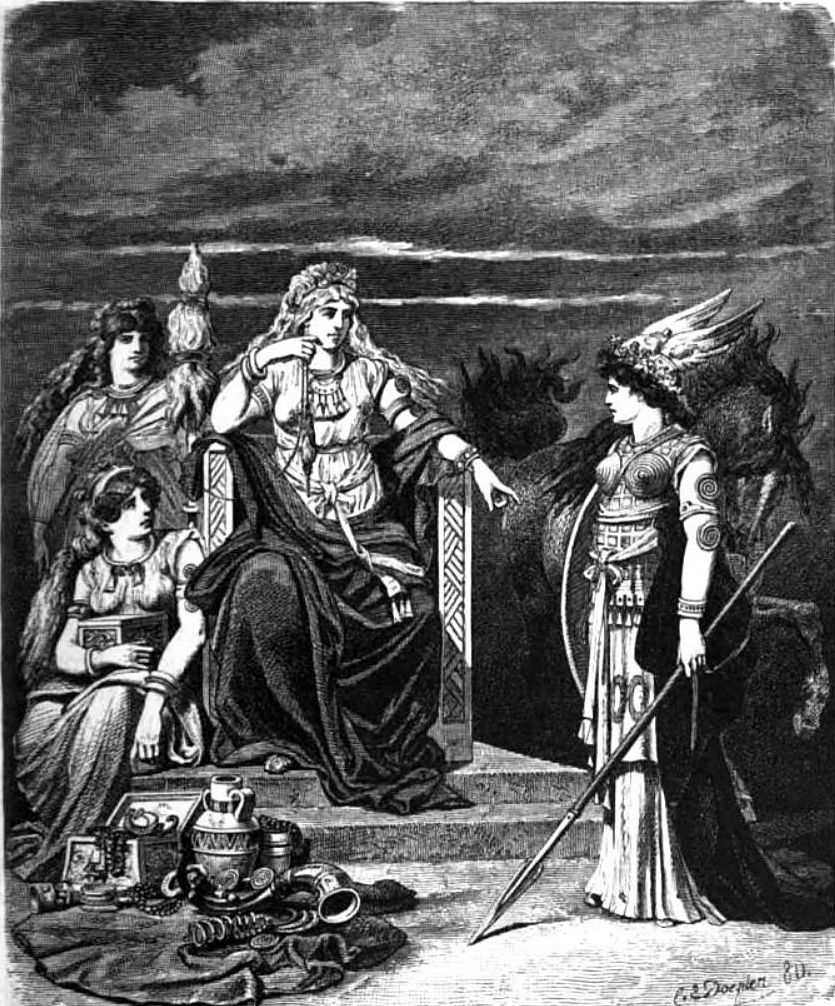
Evidence for the worship of Frig in England (Frigg’s Anglo-Saxon counterpart) comes from the weekday name, Friday (“Frig’s Day”). We also have place-name evidence, for instance, Friden in the Peak District, which, according to the etymologist Kenneth Cameron, was originally Frigedene (“Valley of Frig”).
It’s likely that Frig was associated with fertility in Anglo-Saxon England as she was thought to have similarities to the Roman goddess Venus, who was also associated with sex and fertility. In Old English literature, the common noun “frig” is used to refer to sex.
There is also evidence from comparison with Old Norse religion, in which the goddess Frigg is cognate with Frig. Frigg is the wife of Óđin, mother of Baldr and Hodr, and a seeress. Frigg is linked with fertility. In the Saga of the Volsungs, Frigg hears the prayer of Rerir and his wife, who were desperate for a child. Frigg tells Óđin, who sends help through one of his Valkyries and an enchanted apple.
It’s confusing because there is an idea that Freyja and Frigg were the same goddess in the pre-Viking Age, then were separated into two goddesses. Stephen Grundy examines this idea. Freya is only found in Scandinavian texts, but she does have different attributes: for instance, Freya is the twin of Freyr, whereas Frigg is the wife of Odin.
Historian and archaeologist Ethan Doyle White says that we should consider the Scandinavian Frigg and Anglo-Saxon Frig to be two distinct deities, although he concedes that, “if two individuals from the sixth-century met, one from contemporary Denmark and the other from Kent, it is likely that they would recognize their respective Frigg and Frig as one and the same, just as Germanic-speaking peoples appeared to have seen Frig as being the same deity as the Roman Venus.”
Other Associations
There are lots of other associations with the birch in Germanic and Norse religion. Friedrich Kunze links the birch tree to the Germanic thunder-god Donar. Click the link to read about how, usually, pagan thunder-gods are linked to oak trees!
The thirteenth century skaldic (Old Norse verse) Norwegian Rune poem links Loki to the birch: “Birch has the greenest leaves of any shrub; Loki was fortunate in his deceit.”
The Guðrúnarkviða II from the Poetic Edda (a thirteenth century collection of poems about Old Norse mythology) tells the story of Guðrún’s lament at the murder of her husband Sigurd: “Never so black had seemed the night/As when in sorrow by Sigurth I sat/The wolves…Best of all methought ‘twould be/If I my life could only lose, Or like to birch-wood burned might be.”

Finally, doctoral researcher Jesse Barber explains that, on the The Åland Islands of Swedish-Speaking Finland, local people called in a runkarl (sorcerer) to bind a terrifying troll. The runkarl came carved two runestone that would keep the troll bound to the swamp floor as long as the runes were intact. Local people covered the stones with birch bark in order to protect them.
Our Birch Trees
This has been probably the most difficult topic to research in this series. There are plenty of claims in the literature about the birch tree in Norse and Germanic paganism, but the evidence is patchy, localised and confusing. This is true of research into Anglo-Saxon paganism as a whole—that’s why it’s still sometimes justified to call this period the dark ages; it is still very dark to modern researchers.
Having said that, birch trees are definitely special. Birch trees are good for forming new woodlands—they were among the first trees to colonise Britain after the last ice age! Their role as a “pioneer” species, colonising new ground and then “nursing” the soil and providing shade for other species, might be why people associate birch trees with fertility.

We’ve planted a lot of silver birch trees in our native woodland and we noticed that these are the fastest-growing trees in our wood! A couple of these grew by over 50cm between May and September last year and the tallest now stands at 308cm, having been planted in 2022!
In our next post, read about the rowan tree in Anglo-Saxon paganism! You can also read our posts on ash and oak and yew trees!
Find Out More
If you’d like to learn more about the history of medieval England, take a look at our intellectual and cultural history course, The Medieval Period—or our interdisciplinary course, Culture and Conservation, in which you can explore the links between culture and wildlife all over the world. Alternatively, if you’re interested in religion and folklore, take a look at our Anthropology or Religious Studies courses.
These courses are templates of possible routes of study and can be combined, adapted, or designed from scratch to suit your interests and goals. Dr. Orton will work with you to design a course of private tutorials tailored to your needs, ability and schedule—whether you are undertaking your own research for an independent project, writing a book or simply have a personal interest. Click the link to find out what it’s like to work with her.
Dr. Orton also explores seasonal links with Anglo-Saxon paganism in her post about the pagan festival of yule.
Contact us to find out more!
Do More
For those who would like to take action to preserve our wild spaces, there’s plenty you can do. Find out how we started our wildflower meadow, how we created a wildlife pond and how we are planting a native woodland from scratch! Even if you don’t have a big garden, there are plenty of things you can do to help biodiversity in your area. Why not put up a solitary bee nesting box or insect home, create a woodpile as a habitat for small creatures or leave small areas of your garden to go wild?
You can also support the Woodland Trust’s work to stop ash dieback.
Think about your own area and how you can protect vulnerable but important parts of your own environment. You might even want to start your own project investigating the cultural importance of wildlife in your area. Dr. Orton works with independent scholars undertaking their own research for an independent project, people writing a book or simply those who have a personal interest. Click the link to find out what it’s like to work with her and contact us to get started!
Undertake Your Own Research Project in Wildlife, Religious Studies, Anthropology or History
Contact us for a chat to find out how we can help if you are writing a book, making a documentary, aiming for academic publication or simply pursuing a personal interest. If you’re not ready to reach out yet, follow our Research Methods, British Wildlife, Religious Studies, Anthropology or History series on this blog for more ideas!
Reach Out
Follow our Orton Academy Instagram—we would love to connect with you!
* The first post in this series serves as a caveat for the historical claims in the following posts, as well as the use of certain terminology (“Anglo-Saxon” and “native”).


