
Beautiful Bodies and Divine Geometry: An Introduction to High Renaissance Art and Architecture
- Apr 13
- 11 min read
Updated: Apr 20
In our last post, we saw that Renaissance art aimed at more human-orientated depictions of reality and human emotions using techniques to create volume and spatial depth, such as linear perspective, foreshortening, and chiaroscuro. In the High Renaissance, these trends continued, but there was an extra emphasis on compositional geometry and the perfection of the human form. Find out more in this post and meet some of the biggest stars of the High Renaissance—Leonardo, Michelangelo and Raphael! Part three in our Introduction to Art series.

Art historians define the High Renaissance as beginning around 1490 and ending in 1520 (with the death of Raphael) or in 1527 (with the Sack of Rome by Charles V, Holy Roman Emperor). The High Renaissance is associated with Italian artists like Leonardo da Vinci, Michelangelo Buonarroti (Michelangelo) and Raphael Sanzio da Urbino (Raphael).
Whereas depictions of divine figures like Jesus and Mary in the medieval period were elongated, abstract and flat, the early Renaissance made these figures look real—so real that it was hard to tell that these were meant to be divine figures at all.
One of the marks of the High Renaissance was that artists managed to make divine figures look both real and spiritual. This was done through the idealisation of the human figure.
A second feature was the importance of compositional geometry. A lot of the thinkers of the Ancient Greek Enlightenment—such as Plato and Pythagoras—thought that mathematical perfection was linked to the divine; these ideas influenced the artists of the High Renaissance.
For instance, Giovanni Bellini’s San Giobbe Altarpiece (1487) was made for a church in Venice dedicated to prayers for plague victims. It is a sacra conversazione (depiction of the Virgin and child in the midst of a group of saints from different time periods).
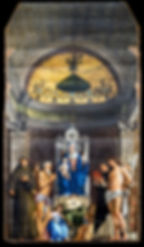
The painting shows Saint Francis with his stigmata (holes in his hands, feet and his side that he received from being close to Christ). Next to him are Saint John the Baptist and Job. On the other side are, Saint Dominic, Saint Louis of Toulouse and Saint Sebastian, an early Christian martyr who was shot with arrows for his beliefs.
The geometry of composition is important in the High Renaissance: the three saints on the left create a pyramid; there is also a pyramid shape on the other side; another pyramid in the three angels at the bottom of the throne; Mary’s body forms a pyramid. Bellini used contrapposto (a stance with the figure’s weight on one leg) and attention to form in the nude figures; another feature of the Renaissance.
Bellini painted architecture that joined the space of the painting with the space of the church, but also that was reminiscent of the church of San Marco in Venice—especially the decorative marble.
Leonardo da Vinci
Leonardo da Vinci trained in Florence and worked for the Medici family. He also worked for Ludovico Sforza, ruler of Milan, as an artist and military engineer and for King Francis I of France. Leonardo was a true Renaissance polymath—as well as being an artist, he was an architect, sculptor, engineer, inventor, mathematician, anatomist and writer.
Like many other artists, Leonardo made preparatory drawings and studies for his commissioned artworks—but the volume of these is exceptional in Leonardo’s case. He often disguised his handwritten notes in mirrored handwriting.
Leonardo made a lot of studies of the human body. His Vitruvian Man (1492) is a drawing of a man with his hands and feet resting on the edges of a circle and square that encompass him. This is Leonardo’s visualisation of first century Roman architect and military engineer Vitruvius’ remarks in Book 3 of De Architectura: “in the human body, the central point is naturally the navel. For if a man be placed flat on his back, with his hands and feet extended, and a pair of compasses centred at his navel, the fingers and toes of his two hands and feet will touch the circumference of a circle described therefrom. And just as the human body yields a circular outline, so too a square figure may be found from it. For if we measure the distance from the soles of the feet to the top of the head, and then apply that measure to the outstretched arms, the breadth will be found to be the same as the height, as in the case of plane surfaces which are perfectly square.”
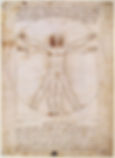
This is only a small drawing for Leonardo’s personal notebooks, but it shows the Renaissance interest in ideal proportions—as well as in classical knowledge. The idea was that the beauty of nature could be improved upon by idealising it.
Leonardo is also known for his depiction of expression. His Mona Lisa is probably the most famous painting in the world, known for the famous smile. Leonardo uses sfumato, a technique that softens outlines and creates atmosphere around the figure.
There is some mystery surrounding the painting, but it’s likely that it is a portrait of the wife of a Florentine merchant. In fact, the portrait was never delivered to its patron, and Leonardo kept it with him when he travelled to France.
Leonardo’s The Last Supper (c. 1495) is on a wall of the Convent of Santa Maria delle Grazie, in Milan. It is damaged because Leonardo used an experimental technique for painting on plaster.

The painting depicts the moment when Christ has just told his disciples that one of them will betray him. Whereas earlier pictures of this theme were usually solemn and quiet. Leonardo’s figures react with terror, disbelief or outrage.
Leonardo’s Portrait of a Lady with an Ermine (1490) (probably) shows the mistress of Ludovico Sforza, the ruler of Milan for whom Leonardo worked.

Here, Leonardo regularises or idealises forms, like the contours of the face, shoulders, and hands. Leonardo also makes shapes in the painting relate to each other—for instance, the face of the ermine to the hand and face of the woman.
Michelangelo Buonarroti
Michelangelo Buonarroti (or just Michelangelo) was trained in Florence and worked there and in Rome. He is known for the paintings in the Sistine Chapel of the Vatican.
Michelangelo was also a sculptor and his Pietà is in St. Peter’s Basilica in Rome. It means “Pity” or “Compassion,” and represents Mary sorrowfully contemplating the dead body of Jesus.
Michelangelo was very hands-on and made a lot of his own tools. He even helped in the dangerous work of quarrying his own marble. He dissected cadavers in order to get a better understanding of the human body for his art. When he made the Pietà between 1498–1500, he was in his early twenties.
Michelangelo clearly thought about making the composition look stable—the bodies of the Virgin Mary and Jesus; Mary’s finger echoes the angle of Jesus’s foot; his right arm is echoed by the drapery at Mary’s side. He also used deep carvings to create light and shadows.
He made the Virgin Mary look much younger than she would have been when Jesus died and (unlike in earlier Pietàs by different artists), he doesn’t make her face distort with emotion—she is idealised. Another adjustment to realism that Michelangelo makes is that he uses oversized drapery to prevent Jesus looking too big as he lies across her body.
Following the success of the Pietà in Rome, Michelangelo was commissioned to make a sculpture of David for the outside of Florence cathedral (it is now in the Galleria dell’Accademia in Florence).
Florence was a at a point at which the Medici family had been run out of town. A powerful monk named Savonarola began to turn the newly reconstituted Republic of Florence into a theocratic state. Savonarola had tried to rid the city of Renaissance art and humanism and had destroyed manuscripts and paintings. Savonarola was eventually excommunicated by the Pope, put under arrest, and executed.
The story of David became even more special to the Florentine people in this context, because the two “giants” of the Medici and Savonarola had been defeated. David became a symbol of the city.
The Florentine people were so impressed with Michelangelo’s David that they wanted it to be in a more prominent position, so it was placed on a platform in front of the Palazzo Vecchio (seat of government in Florence).
Unlike in the earlier versions of David in sculpture, which often depicted him after the fight, Michelangelo has depicted him as he prepares for it. You can see how Michelangelo used humanist ideas and connotations of ancient Rome in the sculpture: David is in a contrapposto stance—a technique associated with the classical arts.
Back in Rome, Michelangelo painted the vault of the Sistine Chapel, whose central space shows nine scenes from the Book of Genesis, between 1508 and 1512. These paintings are frescos (“fresh” in Italian). Pigments are mixed in water and applied directly onto wet plaster. When the plaster dried the colours become an integral part of the wall. Because only enough wet plaster for a day’s work is applied at a time, the daily patches of plaster are still visible when wall paintings are seen close up.
Perhaps the most famous of Michelangelo’s paintings here is The Creation of Adam (1511), which shows God and Adam looking like gods or heroes from Greek or Roman mythology.

These idealised forms were inspired by the sculptures of classical antiquity like the Laocoön, which was excavated in Rome in 1506 and was displayed in the Vatican when Michelangelo worked there. This is a marble sculpture, possibly a copy of a bronze original, ascribed by Roman writer Pliny to a group of first century BC sculptors.
In The Creation of Adam, Michelangelo shows the moment when God has moulded the body of man and is about to animate it. Adam’s body is typical of how Michelangelo paints, with clearly delineated contours and the use of light and shade to create volume. This makes Michelangelo’s painted figures look like sculptures.
You can see the influence of classical techniques in Michelangelo’s other frescos. Look out for the Libyan Sibyl (1511) on the ceiling of the Sistine Chapel. A Sibyl is a future-seer in Greek mythology and Christians believed that the Sibyl had foretold the coming of Christ. Michelangelo used the contrapposto stance for the Sibyl, meaning that her body is twisted.
Raphael Sanzio da Urbino
Raphael Sanzio da Urbino (or just Raphael) was a painter, draughtsman (he made technical plans or drawings) and architect.
Raphael was born in Urbino before moving to Perugia for his training. He later lived in Florence to study the Renaissance masters. Raphael was younger than Leonardo and Michelangelo and was influenced by both of them.
Raphael’s Madonna and Child (c. 1505) uses light that softens the contours of the figures, which is an influence of Leonardo. The serenity and calmness of the figures is characteristic of Raphael, as is the fact that they balance each other in the angles of their heads.

The two figures almost make a pyramid shape, which is also something Raphael learned from Leonardo. This technique makes the image appear stable and permanent and can be seen more explicitly in Raphael’s Madonna del Prato/Madonna with the Christ Child and Saint John the Baptist, which has three figures.

Raphael’s Galatea (1514) is in the Villa Farnesina, one of the retreats built by wealthy people to escape from the city’s summer heat. Galatea was a sea nymph chased by Polyphemus, the one-eyed giant from Homer’s Odyssey. Raphael paints her in a twisted stance, showing his detailed knowledge of the human body.
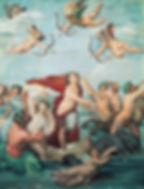
Raphael’s treatment is really different from Botticelli’s early Renaissance The Birth of Venus (1484-1486; another female nude rising from the sea) because of his detailed musculature and use of chiaroscuro (light and shade). It is typical of the High Renaissance because of its complexity. The contortion in her hair and drapery, whipped by the wind, and different directions she is pulled in by the nymphs and sea creatures, add to the dynamism of the composition.
Having said this, there is still compositional stability in the pyramid grouping of the figures—this is also typical of the High Renaissance. Raphael also adds a sense of playfulness in the angel hiding behind a cloud.
Raphael was called to Rome to work for Pope Julius II and was the architect of Saint Peter's Basilica. He also painted a group of murals in the Vatican Palace.
Raphael painted the School of Athens in the Stanza della Segnatura at the Vatican, at the same time that Michelangelo was painting the Sistine Chapel. The Stanza della Segnatura was originally a library and the School of Athens was meant to represent philosophy; on the other walls are frescos representing theology, poetry and justice. Together, these frescos show how classical humanism was united with church teachings.
The School of Athens shows the great philosopher Plato (holding his book Timaeus) and Aristotle (holding his book Ethics) surrounded by other thinkers from Classical Greece. Plato points to the sky (symbolising his focus on abstract concepts), whereas Aristotle focuses his palm downwards (symbolising his empiricism). Other thinkers like Pythagoras, Parmenides, Zeno, Ptolemy, Zoroaster, Heraclitus (modelled on Michelangelo) and Euclid (modelled on the architect Bramante) are also depicted, as well as statues of Apollo and Athena.
Raphael’s Disputa (1510) shows a group of figures contemplating the mystery of the Eucharist and Christ’s miraculous presence. There is the Trinity in the clear vertical axis down the middle of the painting with diminishing golden discs: the dove of the Holy Ghost, Christ, and God the Father. Christ is flanked by the Virgin and St. John the Baptist. To their sides, are figures from the Bible. On either side of the dove are the four books of the gospels and Moses is on the right, holding the 10 Commandments.
Architecture of the High Renaissance
St. Peter’s Basilica in Rome was begun in the High Renaissance—in 1506 (completed in 1626). Pope Julius II commissioned Donato Bramante to build a new basilica on the site of St. Peter’s burial, which already had a fourth century church. When Bramante died, Raphael took over; when Raphael died, Michelangelo took over. Each of these altered the ideas of the one before.
While still living, Bramante created the Tempietto on the Janiculum Hill in Rome. It’s a small round building that marks the site of the crucifixion of St. Peter, linking the authority of the papacy to the saint. Bramante loved the ideal geometries of antiquity, especially those of ancient Greece.
He had wanted to use a Greek cross (a cross with equal arms), circle and square for Saint Peter’s Basilica, although Raphael changed this to a Latin cross (with an elongated nave) after Bramante’s death. Bramante thought that perfect geometry could help people to imagine heaven—a typical characteristic of the High Renaissance.
Find out about the late Renaissance in our next post in the series!
Find out more
Our History and Art History blog has a series on Art History! Dr. Orton has written posts on the botanical illustrations of Enlightenment entomologist Maria Sybilla Merian, Joris Hoefnagel’s botanical illuminations, Ingres’ portrait of Louis-Francois Bertin and the Art History of Siena! She also has a post on the philosophy of Wittgenstein and more philosophical topics on our Philosophy blog.
If you’re interested in tutorials with Dr. Orton, she offers online, one-on-one tutorials that are based around your learning or research needs. This ranges from ad hoc tutorials to gain an understanding of the academic literature, research proposal feedback and development, or regular, ongoing support. For those wanting to know more about Renaissance art and culture, take a look at our Intellectual and Art History course on the Renaissance.
These courses are templates of possible routes of study and can be combined, adapted, or designed from scratch to suit your interests and goals. Dr. Orton will work with you to design a course of private tutorials tailored to your needs, ability and schedule – whether you are undertaking your own research for an independent project, writing a book or simply have a personal interest. Click the link to find out what it’s like to work with Dr. Orton.
Contact us to find out more!
Reach Out
Follow our Orton Academy Instagram—we would love to connect with you!