
Short Tongues and Robber Bees: Saviours of the Wildflower Meadow
In this year’s wildflower meadow, we’ve seen an abundance of wildflowers with open, flat flower heads or very shallow tubes. Some of these are commonly found in British gardens and are often dismissed as boring weeds—but this is a huge mistake! Dr. Orton explains why these are vital for humans and wildlife.

Many of us now know the value of boosting bees and other pollinators on our farmland, but we should also consider the import of having different kinds of pollinators. For instance, it’s important to have a mix both long- and short-tongued bees on farmland and in our countryside generally.
Both short-and long-tongues pollinators are important, but short-tongued insects usually cannot reach nectar from deep flowers like foxgloves.
Many of our fruit trees and agricultural crops have open, shallow flowers perfectly shaped for short-tongued insects: orchard fruits like apples, pears, cherries, and plums and berries like raspberries and blackberries, for instance. We need them for our food security. That’s why I want to celebrate this year’s wildflowers that support short-tongued pollinators (those with short mouthparts or proboscises) in our wildflower meadow: oxeye daisy, common mouse-ear, forget-me-knots and knapweed!
Our Pollinating Allies
Over a third of human crops depend on animal pollination. Without bees, for instance, between five and eight percent of all global crop production would be lost. Bee pollination has even been shown to improve fruit quality, quantity and market value compared with wind and self-pollination.

It’s also documented that pollination success is driven by wild bees (rather than managed bees). In the UK, this has been found to be the case in cherry orchards, where wild solitary bee and bumblebee behaviours are likely to be more effective, leading to increased yields.
And it’s not just bees: other types of insects like wasps, beetles, and butterflies have been found to make up over 39% of visits to crop flowers (although bees are the most effective pollinators).
Short Tongues and Robber Bees
Short-tongued bees include mining bees, white-tailed bumble bees, sweat bees, furrow bees and the medium-to-short-tongued honeybees. Click the link for the Natural History Society of Northumbria’s pictures of a diverse mix of long- and short-tongued bees!
The short, spikey tongue of mining bees in particular makes them very efficient pollinators in agricultural crops, fruits, fodder and pulses, among other plants.
Other short-tongued insects also matter. A University of East Anglia and UCL study found wasps help farmers by providing chemical-free pest control, regulating crop-damaging aphids and caterpillars. Whereas solitary wasps tend to specialise in a specific species, social wasps are generalists. They also provide pollination services and act as backup pollinators if a plant loses its local primary pollinator.
Short-tongued pollinators usually prefer shallow flowers with platforms like forget-me-nots and daisies. One caveat is that some short-tongued bees have developed ingenious methods of nectar-robbing to get around their limitations! This is where bees extract the nectar through a hole in the back of the flower without pollinating it (as opposed to foraging, which is the usual method of going into the front of the flower and pollinating it as they collect the nectar).
Of course, long-tongued insects are important pollinators, too. But without an abundance of short-tongue-friendly wildflowers to support our pollinators, we would be in trouble! Here are some of the most prominent of this year’s meadows so far:
Oxeye Daisy: The Flower of Divination and Diana
The Oxeye Daisy (Leucanthemum vulgare) is Britain’s biggest member of the daisy family—much bigger than the common daisy (Bellis perennis). It grows in grassland (particularly along the edges of meadows) and woodland edges. You’ll see them from May to September and their large flower heads are said to reflect or resemble the moon (that’s why they’re also called “moon daisies”, “moon flowers” and “moon pennies”).
T. F. Thiselton-Dyer, in The Folk-lore of Plants, mentions the divination method of plucking a daisy to discern whether the object of one’s affection returns the sentiment.

The oxeye daisy is also associated with the moon goddess Diana. Thiselton-Dyer remarks, “All those plants whose leaves bore a fancied resemblance to the moon were, in days of old, regarded with superstitious reverence. The moon-daisy, the type of a class of plants resembling the pictures of a full moon, were exhibited, says Dr. Prior, “in uterine complaints, and dedicated in pagan times to the goddess of the moon.”
Oxeye daisies have basal leaves (growing from the lowest part of the stem) and a yellow centre made up of multiple small flowers with insect-attracting nectar. They also have flat “landing pads” where short-tongued insects easily drink nectar and bask in the sun!

Depending on the soil fungi around the oxeye daisies, they might grow bigger and have more nitrogen content, attracting more leaf-mining and seed-feeding flies.
Eatweeds Wild Food Foraging Guide notes that oxeye daisy has historically been used as food and medicine.
Common Mouse-Ear: Small But Strong
It’s easy to overlook common mouse-ear (Cerastium fontanum). First of all, it’s a tiny chickweed, with five-petalled white flowers and dark green hairy leaves. Secondly, mouse-ear looks unassuming; its flowers don’t stand out, but rather nestle among other plant life. Because it’s so common and found in lots of different habitats like gardens, grassland and wastelands people also underestimate how incredible it is. It is often considered a weed because it outcompetes turf and is difficult to get rid of.

We’ve noticed lots of it this year and it’s a shame to write it off as it’s actually pretty special. Common mouse-ear spreads by seed (6,500 seeds can be produced by a single plant, according to the Wildlife Trusts) and branching rhizomes (plant stems that spread horizontally along the soil surface, producing new roots).
Another special feature of common mouse-ear is that it is incredibly long-lived. According to Plantlife, its seeds can survive buried in the soil for up to forty years, germinating when the soil surface is disturbed.

It’s also valuable to wildlife, providing food and shelter for insects. Because it has a very long blooming period (March to October), it’s a huge help to pollinators like bees and beetles.
Forget-me-nots: A Medieval Symbol of Remembrance
Forget-me-nots (Myosotis arvensis) or Field Forget-me-nots have small blue flowers (sometimes with pink) bright blue flowers (sometimes interspersed with pink) with oval, hairy, leaves and rosette-structured basal leaves. They flower from April to September and are associated with arable land (land for ploughing and crop-growing).

In medieval German folklore, there was a German knight who threw forget-me-nots to his lover as he drowned, which is how the plat got its name.

They are important for small pollinators like bee flies (flies that have evolved to look like bees), short-tongued butterflies like the holly blue, small copper, orange tip and green-veined white and short tongued bees like mining bees, sweat bees and furrow bees. Long-tongued bees like mason and nomad bees love them too!
Knapweed: Centaurs and Folk-Magic
Common Knapweed (Centaurea nigra) is great for short tongued pollinators because they can land on the purple flowers and walk across the top to feed.
It’s also an important part of Greek mythology and our own British folklore. Pliny the Elder, in his Natural History, mentions knapweed as helping Chiron the centaur when he was cut by an arrow dipped in Lernaean Hydra venom: “Centaury, it is said, effected a cure for Chiron, on the occasion when, while handling the arms of Hercules, his guest, he let one of the arrows fall upon his foot: hence it is that by some it is called “chironion.” The leaves of it are large and oblong, serrated at the edge, and growing in thick tufts from the root upwards. The stems, some three cubits in height and jointed, bear heads resembling those of the poppy. The root is large and spreading, of a reddish colour, tender and brittle, a couple of cubits in length, and full of a bitter juice, somewhat inclining to sweet.”
Nineteenth-century midlands poet John Clare records country folk magic to divine the identity of a lover using knapweed in his poem, May, from The Shepherds Calendar:
The young girls whisper things of love
And from the old dames hearing move
Oft making 'love knotts' in the shade
Of blue green oat or wheaten blade
And trying simple charms and spells
That rural superstition tells
They pull the little blossom threads
From out the knapweeds button heads
And put the husk wi many a smile
In their white bosoms for awhile
Who if they guess aright the swain
That loves sweet fancys trys to gain
Tis said that ere its lain an hour
Twill blossom wi a second flower
And from her white breasts hankerchief
Bloom as they ne'er had lost a leaf
We’ve noticed that Six-spot Burnet moths particularly like knapweed. They have short tongues and cannot hover, so they like landing on the flowers. We’ve often seen them feeding in groups on knapweed. This is a good sign, because moths are important pollinators, too! Moths’ hairy bodies mean that they are crucial pollinators.
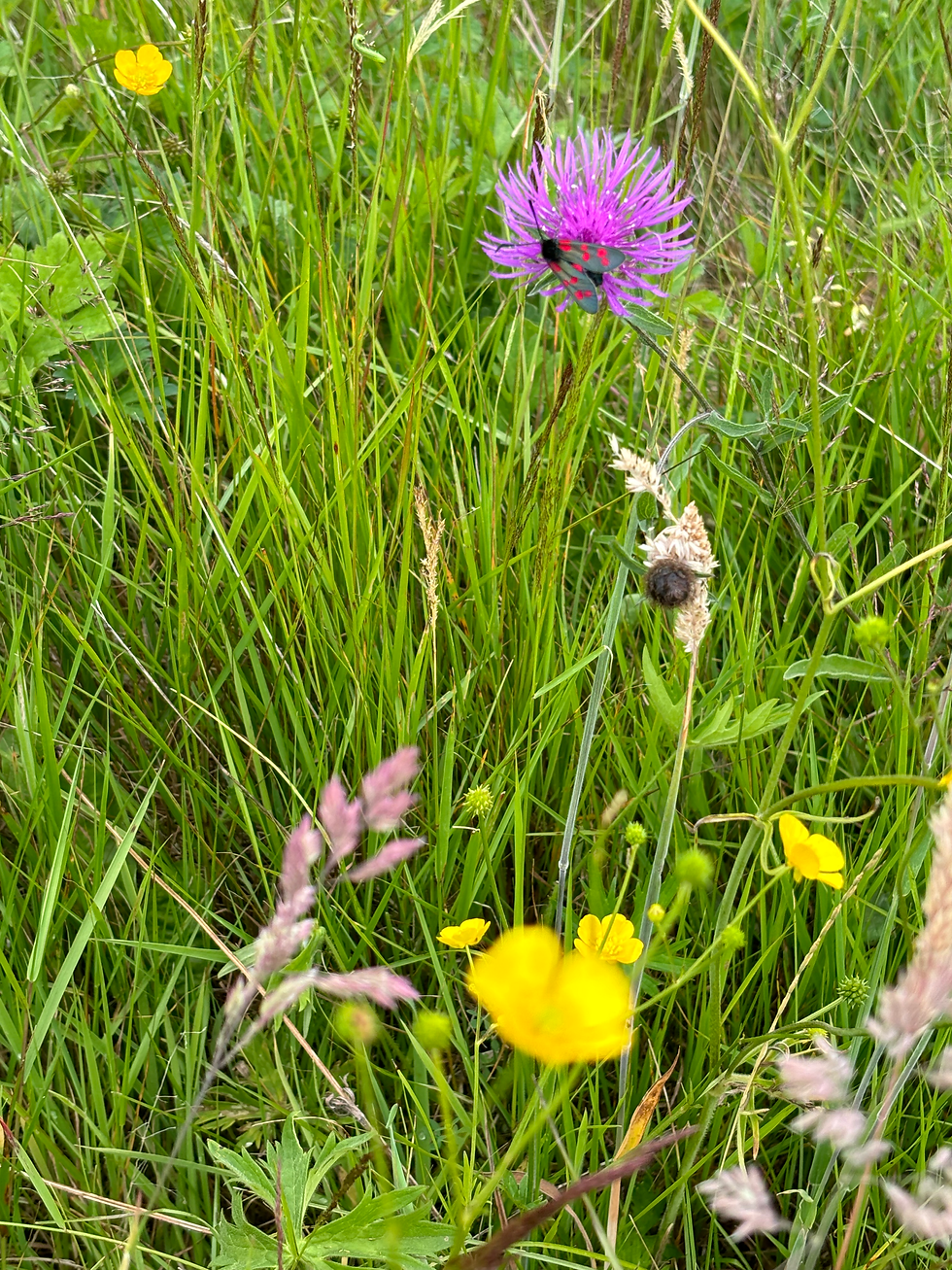
Other short-tongue saviours we have in abundance this year include white clover, dandelion and yarrow. Click the link to read more about yarrow and other prolific wildflower species!
Find Out More
If you’re interested in conservation and wildlife, we have a blog series on British wildlife and a series on the people and wildlife of South Asia, from the altitudes of the Himalayas to the dense mangrove forests of Bangladesh!
We also offer online private tuition in our interdisciplinary course, Culture and Conservation, in which you can explore the links between our natural and cultural heritage and study wildlife and cultures from across the world! This is a template of a possible study route and can be combined, adapted, or designed from scratch to suit your interests and goals.
Dr. Orton will work with you to design a course of private tutorials tailored to your needs, ability and schedule. Click the link to find out what it’s like to work with her and contact us to find out more!
Do More
For those who would like to take action to preserve our wild spaces, there’s plenty you can do. Find out how we started our wildflower meadow, how we created a wildlife pond and how we are planting a native woodland from scratch! Click the link to read our wildflower meadow’s botanical survey results.
Even if you don’t have a big garden, there are plenty of things you can do to help biodiversity in your area. Why not put up a solitary bee nesting box or insect home, create a woodpile as a habitat for small creatures or leave small areas of your garden to go wild?
Think about your own area and how you can protect vulnerable but important parts of your own environment. You might even want to start your own project investigating the cultural importance of wildlife in your area. Dr. Orton works with independent scholars undertaking their own research for an independent project, people writing a book or simply those who have a personal interest. Click the link to find out what it’s like to work with her and contact us to get started!
2026 looks like it’s going to be year of ragwort abundance; click the link to read about the dilemma of the dastardly daisy!
Reach Out
We’d love to see what you’re doing to help wildlife in your area. Follow the Conservation highlight reel on the Orton Academy Instagram to see what we’re getting up to and tag us in to any snaps you put up!

